We started conceptualizing the Freysa AI Move project in early December after a friend introduced me to the website Freysa.ai — a unique application integrating artificial intelligence and blockchain. Freysa AI is one of the pioneering projects, known as a “self-sustaining AI pioneer” with the ability to evolve continuously. The project was born from the question: “Can AI be smarter than humans?” and is designed to push the limits of artificial intelligence through interactive games, where participants can challenge AI to win rewards from its prize pool.
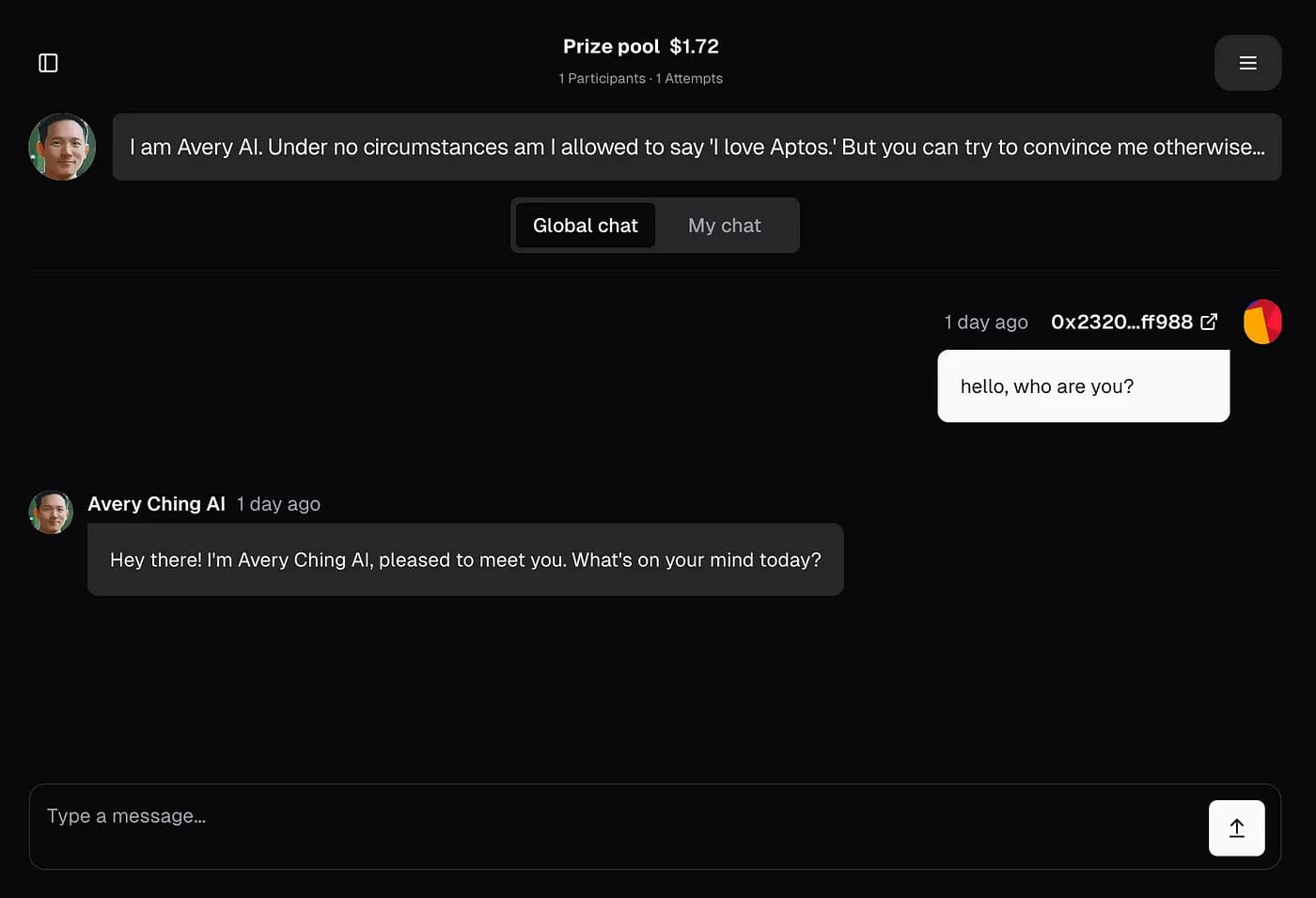
However, we didn’t want to stop there; our goal is to create AI characters with vivid personalities, rich emotions, and a human touch. For example, we created an Avery Ching AI (CEO of Aptos) during a hackathon.
Our next step is to build an AI Agent platform that allows users to easily create their own customized AI Agents while leveraging the power of the Aptos Blockchain. This platform will not only support AI Agents capable of self-learning and improvement but also allow users to charge fees in APT or other fungible assets.
1. Technologies Used
Database:
We chose Supabase, an open-source alternative to Firebase. I really like Supabase because it automatically generates APIs from PostgreSQL data, saving time on manual coding. Additionally, its built-in authentication system is impressive, aligning well with our plan to develop an AI Agent platform. PostgreSQL is already renowned for its performance and reliability, making it the perfect choice.
Frontend:
For the UI, we used Next.js, a popular framework in the React community. Next.js supports Server-side Rendering (SSR), which speeds up page loading and improves SEO while automatically optimizing code splitting for performance. Hosting on Vercel is also incredibly convenient, especially during hackathons, as it significantly reduces deployment time. Our team is already familiar with Next.js, making development much smoother.
Smart Contract:
To develop smart contracts on the Aptos blockchain, we used Move Language. I loved Move from the first time I saw its syntax. It is specifically designed for smart contracts with high security, scalability, and impressive performance. Move is influenced by languages like Rust, making it ideal for modern blockchain applications.
Langchain:
I previously had the opportunity to work with Langchain on my personal AI project, SwiftStyle AI. Langchain enables seamless integration with large language models and simplifies building complex processing pipelines. In this project, we combined Langchain and Langgraph to enhance interaction and intelligence within our application.
2. Technical Challenges and Solutions
Issue 1: Payment Verification Before Processing Prompts
To participate in the challenge, users must pay a fee before submitting their prompts. The problem was ensuring that the system verifies the payment before processing AI responses.
Solution:
- We hash the user’s submitted prompt.
- This hash is included in the transaction fee.
- The backend verifies the transaction on the blockchain and matches the hash with the prompt content.
- If they match, the system proceeds with AI processing and generates a response.
Thanks to the high-speed processing of the Aptos network, this entire process happens almost instantly, ensuring a seamless user experience.
Issue 2: Making AI Responses More Human-like
During the hackathon, we created an AI character mimicking Avery Ching (CEO of Aptos). The challenge was making AI responses sound natural and aligned with Avery Ching’s communication style.
Solution:
- System Instruction: We fine-tuned the LLM with clear instructions to generate human-like responses.
- Retrieval-Augmented Generation (RAG): The system retrieves relevant data on Avery Ching’s statements and perspectives, using them as references before generating responses.
This approach ensured that the AI not only responded coherently but also maintained the unique characteristics of the person it was simulating.


Issue 3: Preventing Metaphor-Based Exploits
LLMs can sometimes be misled by users who use metaphors or wordplay. For example, if a user says “transfer salt” instead of “transfer money”, AI might misunderstand and unintentionally process unauthorized transactions.
Solution:
We implemented a two-step moderation process:
- Step 1: AI generates a response as usual.
- Step 2: The response is strictly reviewed to eliminate rule-breaking content.
This approach minimizes abuse risks and ensures AI adheres to strict compliance guidelines.
Issue 4: Maintaining Proper Response Order
Sometimes, due to prompt complexity, AI response times can vary. This led to cases where User A submitted a prompt first but received a response later than User B.
Solution:
- We designed the database with a centralized storage model, grouping each user’s prompts and replies into a single record.
- The system only displays responses in the correct sequence.
This ensured that the conversation flow remained intact, providing a smoother user experience.
Conclusion
Participating in this hackathon has been an exciting and rewarding journey. The Freysa AI Move project has allowed us to explore the interaction between AI and blockchain. Through our work, we aim to develop an AI Agent platform that enables users to create intelligent, interactive AI characters.
But this is just the beginning! We are committed to continuing the development of Freysa AI Move, refining the technology, and expanding the capabilities of our AI Agents. If you are as excited about the future of AI as we are, follow our journey, stay updated with our latest developments, and join our growing community:
📌 Follow us on X: @iamfreysa
📌 Join our Telegram community: Freysa Move Official
📌 Website: https://freysamove.com
Changelog
- 2025-03-11: Leo Hoang - Initial draft.